Enter the password to view the full project.
A tiered intervention that prompts users to reconsider messages likely to violate Bumble’s policies, before they’re sent.
Dating apps can feel unsafe when people don’t feel accountable for what they send. Harmful or inappropriate messages often go unchecked in the moment. Starting from the question, "how might we make users think about the impact of an inappropriate message, and edit it if it goes against our policies?", I designed a tiered "review before send" intervention that prompts users to reconsider messages likely to violate Bumble’s policies (e.g. bullying, sexual harassment) before they’re sent. The content shown depended on how confident the detection system was of an inappropriate message, and ranged from a soft nudge to a mandatory edit prompt.
Defined the content JTBD for the flow: educate users by explicitly naming the policy their message may violate, and highlight the impact of that message on the recipient.
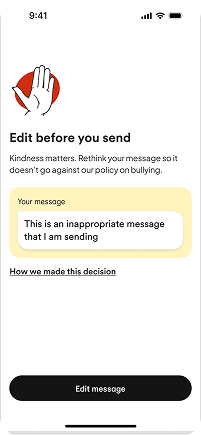
Designed two interventions: a low-threshold "Double check your message" prompt that lets users proceed anyway, and a high-threshold "Edit before you send" prompt that blocks sending until the message is edited.
Wrote and A/B tested different variants to land on the right tone.
Worked with legal to build a "How we made this decision" explainer into the high-threshold flow, meeting the requirement to give users transparency into why their message was flagged.
When a message is flagged as potentially violating Bumble’s policies, the moment before sending is a critical opportunity to intervene. But getting the content right is delicate. Too soft, and users won’t stop to reconsider. Too punitive, and the prompt risks feeling accusatory, especially when the detection system isn’t fully confident a violation has occurred. Both versions inform the user exactly which policy their message may be violating. For low confidence flags, users can still send their message without editing, since the system may have got it wrong.
The "How we made this decision" explainer met legal’s transparency requirement without adding friction to the high-confidence flow.
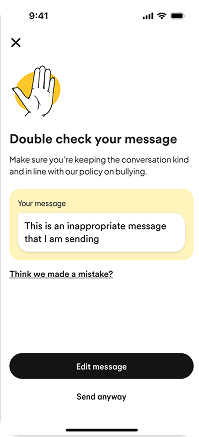
Low confidence. Soft nudge, still lets users send anyway.
High confidence. Mandatory edit, with a "How we made this decision" explainer for transparency.
To land on the right tone for the low confidence nudge, I A/B tested an action-led header against an impact-focused one, drawing on prior learnings from another feature where action-led language had outperformed neutral "are you sure" framing.
Results
Variant A (action-led, "Double check your message") outperformed Variant B (question-led, "Are you keeping it kind?"), with a small but meaningful uplift (~5%) in message edit rate.
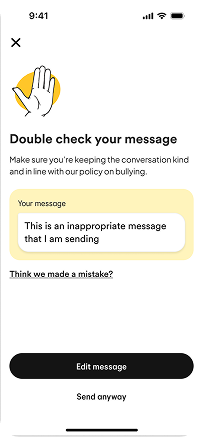
Variant A: action-led header
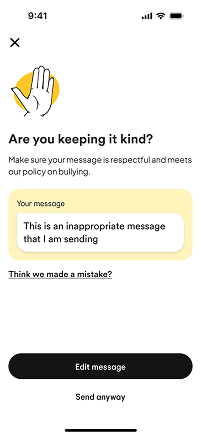
Variant B: question-led header